For businesses that sell, resell, manufacture, or distribute physical products, inventory typically represents the largest asset on the balance sheet. Yet inventory accounting remains one of the most misunderstood aspects of financial management.
When inventory systems don't align with accounting platforms, the financial consequences compound quickly: distorted gross margins, inaccurate cost of goods sold (COGS), balance sheet discrepancies, and operational decisions based on unreliable data.
This guide explains what inventory accounting is, how it differs from basic bookkeeping, the valuation methods that affect your tax liability, and nine structural benefits that operational businesses between $1M and $30M in revenue should prioritize.
Explore Our Inventory Accounting Integration Services Here →
What Is Inventory Accounting?
Inventory accounting is the systematic tracking, valuation, and financial reporting of goods held for sale, manufacturing, or distribution. It includes the methods and systems used to record inventory costs, monitor stock levels, allocate landed costs, calculate cost of goods sold (COGS), and ensure financial statements accurately reflect operational reality.
3 Types of Inventory Businesses Must Track
Before beginning inventory accounting services, identify which inventory types your business manages:
1. Inventory for Resale (Retail & Wholesale)
Products purchased for resale without modification. This includes retail store stock, wholesale distributor inventory, and ecommerce product catalogs. Drop-shipped products where you never take possession do not qualify as inventory assets.
2. Inventory for Installation or Service Delivery
Parts, components, or products sold as integral elements of a service. Examples include spare parts sold by repair businesses, HVAC components installed during maintenance contracts, or equipment provided during installations.
3. Inventory for Manufacturing
Materials transformed into finished products. Manufacturing inventory is categorized into three accounting classifications:
Raw Materials: Unprocessed inputs purchased for production (fabric, metals, chemicals, packaging)
Work in Progress (WIP): Partially completed goods still in production
Finished Goods: Completed products ready for sale
Inventory Accounting Fundamentals: What You Must Track
Effective inventory accounting requires tracking multiple interconnected data points that affect financial reporting, tax liability, and operational decisions.
Essential Inventory Metrics
Cost of Goods Sold (COGS): Direct costs of producing or acquiring sold products
Landed Costs: Total acquisition cost including freight, duties, customs, storage, and handling
Inventory Shrinkage: Losses from damage, theft, spoilage, or obsolescence
Stock on Hand: Real-time quantity available across all warehouse locations
Unit Economics: Per-item cost, selling price, and contribution margin
Inventory Turnover Rate: How frequently inventory sells and is replaced
Seasonal Sales Patterns: Demand fluctuations by SKU, category, and time
Inventory Valuation Methods: FIFO, LIFO, and Weighted Average Cost
Your chosen inventory valuation method directly affects cost of goods sold, gross profit, and tax liability. The three primary methods approved by Generally Accepted Accounting Principles (GAAP) are:
FIFO (First In, First Out)
FIFO assumes the oldest inventory is sold first, leaving newer (often higher cost) inventory on the balance sheet.
Best for: Businesses with perishable goods, rapidly obsoleting products, or those seeking to present higher profitability to lenders and investors.
Tax impact: Lower COGS = Higher gross profit = Higher tax liability in inflationary environments.
Financial statement impact: Balance sheet inventory values more closely reflect current replacement costs.
LIFO (Last In, First Out)
LIFO assumes the most recently acquired inventory is sold first, leaving older (often lower cost) inventory on the books.
Best for: Businesses seeking tax deferral in inflationary periods where replacement costs are rising.
Tax impact: Higher COGS = Lower gross profit = Reduced tax liability.
Financial statement impact: Balance sheet may understate inventory value since it reflects older, lower costs. May not correspond to actual physical inventory flow.
Note: LIFO is not permitted under International Financial Reporting Standards (IFRS).
Weighted Average Cost (AVCO)
Weighted average calculates a blended cost across all inventory purchases, recalculated each time new inventory is acquired.
Best for: Businesses with stable pricing, commoditized products, or those seeking simplified accounting without extreme price fluctuations.
Tax impact: Moderate, falls between FIFO and LIFO.
Financial statement impact: Smooths out price volatility, providing more predictable gross margin reporting. Less accurate during periods of severe price fluctuation.
9 Strategic Benefits of Inventory Accounting for Operational Businesses
When inventory accounting is structurally aligned with operations, businesses gain compounding advantages that extend far beyond compliance.
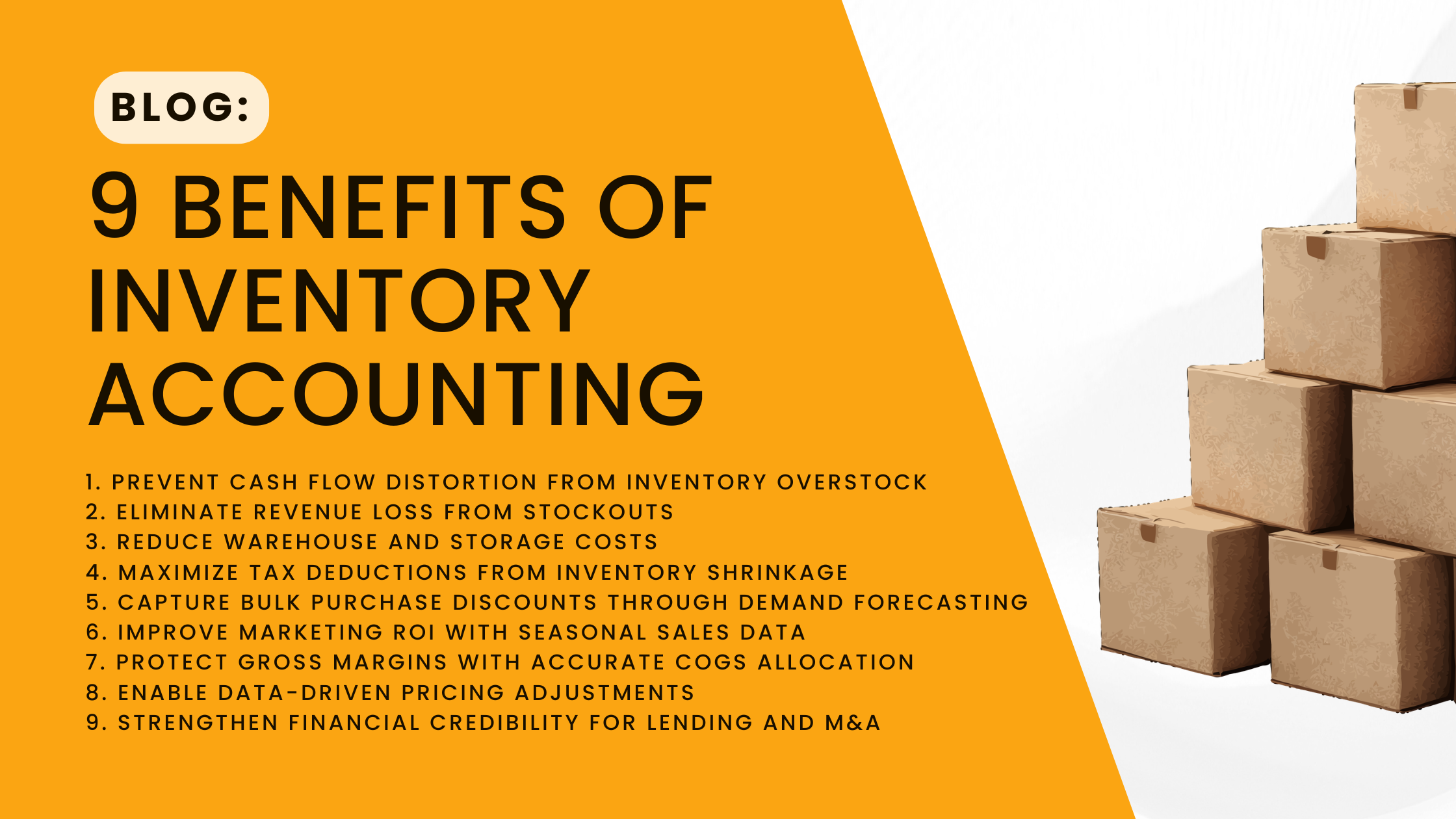
1. Prevent Cash Flow Distortion from Inventory Overstock
Accurate inventory tracking prevents excessive capital from being tied up in slow-moving or obsolete stock. Real-time visibility into stock levels and turnover rates ensures cash remains available for operational expenses, payroll, and growth investments rather than sitting idle in warehouses.
2. Eliminate Revenue Loss from Stockouts
Integrated inventory systems provide advance warning before high-demand products run out. Automated reorder point notifications prevent lost sales, backorders, and customer dissatisfaction caused by insufficient stock during peak demand periods.
3. Reduce Warehouse and Storage Costs
Identifying slow-moving SKUs through sales velocity reporting allows businesses to reduce reorder frequency, negotiate better warehouse terms, or discontinue unprofitable products. Lower storage costs directly improve net margins.
4. Maximize Tax Deductions from Inventory Shrinkage
Properly documented inventory losses from damage, theft, expiration, or obsolescence are tax-deductible. Accurate shrinkage tracking ensures businesses capture the full deduction rather than absorbing unrecorded losses that inflate taxable income.
5. Capture Bulk Purchase Discounts Through Demand Forecasting
Sales trend analysis reveals which products move consistently at high volume. Businesses can leverage this data to negotiate volume discounts, reduce per-unit costs, and improve gross margins without increasing risk of overstock.
6. Improve Marketing ROI with Seasonal Sales Data
Historical sales patterns by season, month, or promotional period allow marketing teams to time campaigns when demand is proven. Inventory-based insights prevent wasted ad spend on slow periods and maximize conversion during high-intent windows.
7. Protect Gross Margins with Accurate COGS Allocation
Misallocated costs distort profitability analysis at the SKU level. Accurate landed cost allocation including freight, duties, and handling; ensures pricing decisions are based on true cost structure, preventing margin erosion from underpriced products.
8. Enable Data-Driven Pricing Adjustments
Fully tracked costs provide visibility into which products drive profit and which operate at break-even or loss. Businesses can adjust pricing strategically, discontinue unprofitable SKUs, or double down on high-margin products with confidence.
9. Strengthen Financial Credibility for Lending and M&A
Lenders, investors, and acquirers scrutinize inventory accounting accuracy during due diligence. Clean, reconciled inventory records with defensible valuation methods increase confidence, expedite financing approvals, and support higher business valuations.
When Basic Inventory Tracking Isn't Enough: Signs You Need Inventory Accounting Integration
Growing operational businesses often outgrow basic inventory tracking when:
Gross margins fluctuate unexpectedly month-to-month without operational cause
Physical inventory counts never match accounting system balances
Ecommerce deposits don't reconcile cleanly to sales revenue
Multi-warehouse operations lack consolidated reporting
ERP implementations never fully stabilized after go-live
Financial statements are unreliable for strategic decision-making
Lenders or auditors question inventory valuation during reviews
These symptoms indicate structural misalignment rather than transactional errors. Addressing them requires inventory accounting integration.
How Certum Aligns Inventory Accounting for Complex SMBs
Certum specializes in the operational complexity that sits between DIY systems and enterprise-scale ERP consulting. We work with U.S.-based businesses generating $1M–$30M in revenue who manage physical products across multiple sales channels, warehouses, or manufacturing workflows.
Our inventory accounting integration services focus on:
System alignment between accounting and inventory platforms (QuickBooks, Cin7, Katana, Odoo)
COGS accuracy across ecommerce, wholesale, and multi-channel sales
Landed cost allocation and freight reconciliation
Margin protection through structural cost validation
ERP stabilization and post-implementation rescue
Operational reporting that reflects real-time inventory movements
Unlike transactional bookkeeping services, our approach diagnoses root causes of inventory-accounting misalignment, stabilizes system architecture, integrates multi-platform workflows, and provides ongoing advisory oversight.
Frequently Asked Questions About Inventory Accounting
What is the difference between inventory management and inventory accounting?
Inventory management tracks physical stock levels, reorder points, and warehouse movements. Inventory accounting translates those operational activities into financial data; recording costs, calculating COGS, valuing inventory assets, and ensuring financial statements accurately reflect inventory transactions.
Which inventory valuation method reduces taxes?
LIFO (Last In, First Out) typically reduces tax liability during inflationary periods by matching the highest-cost inventory against current sales, which increases COGS and reduces taxable profit. However, LIFO is not permitted under IFRS and may understate balance sheet inventory values.
Can small businesses use FIFO accounting?
Yes. FIFO is widely used by small and mid-sized businesses, particularly those with perishable goods or products subject to obsolescence. FIFO provides more favorable gross profit presentation to lenders, though it may increase tax liability compared to LIFO.
How does inventory accounting affect cost of goods sold?
The inventory valuation method you choose (FIFO, LIFO, or weighted average) directly determines which costs flow into COGS when products are sold. Higher COGS reduces gross profit and taxable income; lower COGS increases both. Accurate landed cost allocation ensures COGS reflects true acquisition expenses.
What software integrates inventory with accounting?
QuickBooks integrates with inventory platforms like Cin7, Katana, and Odoo. Ecommerce channels (Shopify, Amazon, WooCommerce) require middleware or API connections to sync sales, deposits, and inventory movements. Proper integration requires chart of accounts alignment, subledger validation, and clearing account reconciliation.
When should a business hire an inventory accountant?
Businesses should consider specialized inventory accounting support when gross margins become unreliable, physical counts don't match system records, multi-channel sales create reconciliation chaos, or when preparing for lending, acquisition, or ERP implementation. Typically, this occurs between $1M and $30M in annual revenue.
Stop Guessing. Start Knowing.
Inventory accounting isn't optional for growing product businesses; it's the foundation that determines whether your financial statements reflect operational reality or merely balanced transactions. If your inventory systems and accounting platforms don't align, every decision based on that data carries compounding risk.
Certum specializes in diagnosing, stabilizing, and integrating inventory accounting for operationally complex businesses between $1M and $30M. We don't just reconcile transactions; we rebuild the structural integrity that makes reliable reporting possible.
Ready to align your inventory accounting?
Schedule a free consultation to begin discussing how Certum can assess your current systems and how you can receive a transparent proposal based on complexity, not sales pressure.
Related Pages on the Certum Solutions Website
Get a free quote (it takes 2 minutes) Use our free quote builder to get an idea on pricing for bookkeeping, accounting, and tax services for your business! It’s free to use and we don’t collect your information when you do. Book a free consultation if you’d like to proceed and we’ll get you onboarded!