QUICK SUMMARY: Hiring an employee who works in another state usually means:
registering as an employer in that state
withholding that state's income tax
setting up state unemployment insurance
updating HR policies for that state's employment laws
This checklist is for U.S. business owners and finance leads hiring out of state for the first time. It includes Charlotte-area examples for NC and SC employers. Certum Solutions walks through each step and the accounting setup most guides skip. Get help setting up multi-state payroll →
The offer is accepted; the start date is set, and then someone asks the question that stalls onboarding: we've never had an employee in that state, so what do we have to do? For businesses in the Charlotte metro, the answer often comes up the first time a hire lives in Fort Mill, Rock Hill, or Indian Land instead of Mecklenburg or Union County.
Certum Solutions has set up and reconciled payroll for growing businesses nationwide for more than 15 years. As a Paychex partner and Elite QuickBooks ProAdvisor based in Monroe, NC, Certum sees the same multi-state mistakes repeated across industries. Most of them are expensive to unwind after the fact.
This guide is written for U.S.-based business owners, controllers, and operators making their first out-of-state hire in 2026. It covers the seven steps, a copy-ready checklist, an NC/SC example, and the accounting setup that keeps multi-state payroll reconciled. State rules vary, so confirm the specifics for your states with a tax professional before your first payroll.
First out-of-state hire on the calendar?
We'll confirm registrations, withholding, and chart of accounts setup before day one.
What Changes When You Hire an Employee in Another State?
Hiring an employee who works in another state generally means your business must register as an employer there. You then withhold that state's income tax (where it has one), pay into that state's unemployment insurance program, and follow its employment laws. Your headquarters state's rules no longer cover everyone on payroll.
Step 1: Confirm Where the Work Is Physically Performed
Most states tax wages based on where the employee physically does the work, not where the company is headquartered. South Carolina is a clear example: South Carolina uses a physical presence rule, so wages count as South Carolina income when the work is physically performed there, regardless of where the employer is located.
A small number of states apply different rules, such as New York's "convenience of the employer" test. Confirm each state's sourcing rule before assuming. Also document where each remote employee works and require notice before an employee relocates.
Step 2: Check Whether the States Have a Reciprocity Agreement
A reciprocity agreement lets an employee pay income tax only to their home state, even if they work in another. These agreements exist between some neighboring states, but not all. North Carolina and South Carolina do not have one, and South Carolina currently has no reciprocity agreements with any state.
Step 3: Register as an Employer in the New State
Registering as an employer means opening a withholding account with the new state revenue department before you run payroll there. A business based outside South Carolina that hires a remote employee living and working in the state generally must register with the South Carolina Department of Revenue so it can withhold and remit South Carolina income tax.
Ask your advisor whether having an employee in the new state also requires you to register your business there as a foreign entity. The answer depends on the state and on what your business does there.
Step 4: Set Up State Unemployment Insurance Correctly
State unemployment insurance (SUI) is generally paid to the state where the employee's work is based, which isn't always the state where you withhold income tax. Each state assigns its own SUI rate and account number, and new employers usually start at a standard new-employer rate.
Reporting wages to the wrong state's unemployment program is a common error. It can mean paying twice and then filing for refunds.
Step 5: Update Your Employee Handbook and Policies for the New State
Updating your handbook is the step businesses skip most often, because no system forces it. The new state may have different rules for:
paid sick leave
final paycheck timing
meal and rest breaks
non-competes
required notices
A state addendum to your existing handbook is the usual fix. HR compliance software like SixFifty can generate state-specific addenda and keep them current as laws change. Our honest SixFifty HR compliance software review →
Step 6: Handle Posters, Notices, and New-Hire Reporting
Every state requires employers to report new hires to a state directory within a set number of days. Most states also require specific workplace posters and notices, which remote employees need to receive electronically. Labor poster requirements for remote employees →
Step 7: Map Multi-State Payroll to Your Chart of Accounts
Multi-state payroll needs a separate liability account for each state's withholding and each state's unemployment tax. A single lumped "Payroll Liabilities" account won't do. Without that separation, your bookkeeper can't tell which state an unpaid balance belongs to, and year-end reconciliation turns into forensic work.
For businesses that track labor cost by location or job, payroll should also flow to the right class, location, or project. That applies to QuickBooks Enterprise, Intuit Enterprise Suite, Xero, and Zoho Books. Certum sets up this mapping during payroll onboarding and reconciles it monthly. Paychex payroll setup tied into your accounting system →
Payroll liabilities not reconciling by state?
Our senior accountants will untangle multi-state payroll in your books and set it up to stay clean.
Charlotte-Area Example: NC Employers With South Carolina Employees
The Charlotte metro spans two states. That makes NC/SC payroll one of the most common multi-state setups for businesses in our region. The scenarios below are general. Confirm your situation with a tax professional.
An SC Resident Who Commutes to Your NC Office
When a South Carolina resident physically works in your North Carolina office, the employer typically withholds North Carolina income tax. The employee files returns in both states. Filing in both North Carolina and South Carolina usually does not mean paying tax twice on the same income, because the home state generally provides a credit for tax paid to the other state.
An SC Resident Who Works Remotely From Home
When a South Carolina resident works remotely from home in South Carolina for your North Carolina company, the wages are generally South Carolina-source income. Your business likely needs to register with the SC Department of Revenue, withhold SC income tax, and review SC unemployment registration.
A Hybrid Employee Who Splits Time Between States
A hybrid employee who splits time between an NC office and an SC home office may create withholding obligations in both states, based on where the work actually happens. Track work location days and set payroll allocation accordingly.
The Multi-State Payroll Checklist
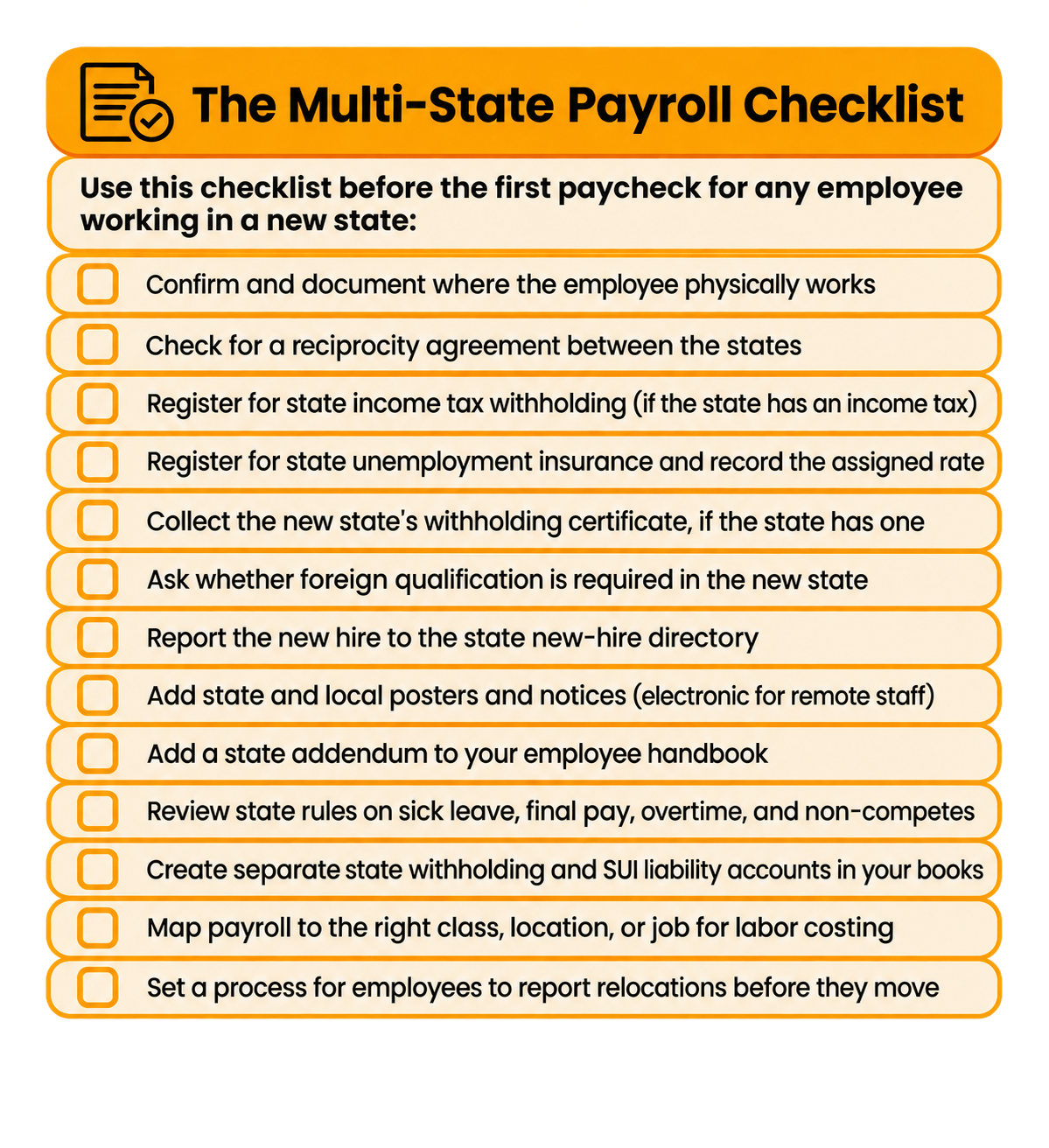
Use this checklist before the first paycheck for any employee working in a new state:
Confirm and document where the employee physically works
Check for a reciprocity agreement between the states
Register for state income tax withholding (if the state has an income tax)
Register for state unemployment insurance and record the assigned rate
Collect the new state's withholding certificate, if the state has one
Ask whether foreign qualification is required in the new state
Report the new hire to the state new-hire directory
Add state and local posters and notices (electronic for remote staff)
Add a state addendum to your employee handbook
Review state rules on sick leave, final pay, overtime, and non-competes
Create separate state withholding and SUI liability accounts in your books
Map payroll to the right class, location, or job for labor costing
Set a process for employees to report relocations before they move
Common Multi-State Payroll Mistakes We See
The multi-state payroll errors that show up most often in Certum's client work are:
Withholding the headquarters state's tax for a remote employee who works elsewhere
Assuming NC and SC have a reciprocity agreement (they don't)
Reporting unemployment wages to the wrong state
Updating payroll but not the handbook
Not learning an employee moved until year-end W-2s go out
Lumping every state's liabilities into one account, so nothing reconciles
Can Your Current Payroll System Handle Multiple States?
Most full-service payroll platforms support multi-state withholding. The differences show up in how much of the registration and ongoing compliance they handle for you. Paychex Flex handles multi-state payroll tax filing, and Paychex pairs it with HR support and SixFifty compliance tools for the policy side. Businesses already inside QuickBooks may prefer QuickBooks Payroll, and very small teams sometimes start on Gusto.
When DIY Multi-State Payroll Makes Sense, and When It Doesn't
Handling multi-state payroll yourself can work for one remote employee in a neighboring state, with a full-service payroll provider and a bookkeeper who reconciles liabilities monthly. It stops making sense in these situations:
employees in three or more states
hybrid workers splitting time between states
locations with local income taxes
no one internally who owns HR policy
Frequently Asked Questions About Multi-State Payroll
Do I have to register in another state if I hire a remote employee there?
In most cases, yes. Most states require an employer to register for income tax withholding and unemployment insurance when an employee physically works in that state. That applies even if the business has no office there.
Which state do I withhold taxes for a remote employee?
Employers generally withhold income tax for the state where the employee physically performs the work. Exceptions include reciprocity agreements between certain states and "convenience of the employer" rules in a few states.
Do North Carolina and South Carolina have a reciprocity agreement?
No. North Carolina and South Carolina do not have a reciprocal income tax agreement. Employees who live in one state and work in the other typically file in both states and claim a credit on their home-state return for tax paid to the other state.
If my employee lives in South Carolina but works in my North Carolina office, which state do I withhold for?
Employers typically withhold North Carolina income tax when the work is physically performed in North Carolina. The South Carolina resident then files a South Carolina return and generally claims a credit for tax paid to North Carolina. Confirm your specific situation with a tax professional.
Does an out-of-state employee need a different employee handbook?
An out-of-state employee usually doesn't need a completely separate handbook. They do typically need a state-specific addendum covering that state's rules on leave, final pay, breaks, and other requirements. HR compliance software like SixFifty can generate and update these addenda.
What happens if I withhold for the wrong state?
Withholding for the wrong state can trigger penalties and interest from the state that should have received the tax. It also puts the wrong state on the employee's W-2 and creates amended filings for both the business and the employee. Catching it early keeps corrections simpler.
How should multi-state payroll be set up in QuickBooks or Xero?
Multi-state payroll should use separate liability accounts for each state's income tax withholding and each state's unemployment tax. Payroll should map to classes, locations, or jobs where labor costing matters. That structure lets each state's balance reconcile independently every month.
Can Certum Solutions help set up multi-state payroll?
Yes. Certum Solutions coordinates multi-state payroll setup through providers like Paychex; maps payroll to your accounting system and reconciles state liabilities monthly. Certum serves businesses nationwide. Book a free multi-state payroll consultation →
Hire the best person, wherever they live.
We'll handle the payroll, HR, and accounting setup, so the state line isn't your problem.
BUTTON: Book a Free Consultation →
Free Resources