QUICK SUMMARY: This year-end accounting checklist walks U.S. business owners and finance managers through closing 2026 in the right order: records first, then payroll, 1099s, the books, and tax moves that must happen before December 31. It covers what changed for 2026, including the new $2,000 threshold for Form 1099-NEC, new Form W-2 codes for overtime and tips, and the 2027 Social Security wage base of $192,300. North Carolina businesses get the state deadlines most national checklists skip. Download the free Certum Year-End Close Checklist →
Every January, the same three problems land on business owners at once. W-2s are due; contractors want their 1099s, and the tax preparer is asking for books that are not reconciled yet. Most of those problems were set in motion in November, when nobody had time to look.
Certum Solutions has spent more than 15 years closing books for growing businesses, and our founder Katherine "Katie" Bunschoten has worked in accounting for over 20 years. We have been a QuickBooks Elite Partner since 2012, and every bookkeeping client we serve gets a monthly review from a senior accountant. This checklist reflects how our own team closes the year for clients, not a generic list of reminders.
This guide is written for U.S.-based small and mid-sized business owners, roughly $1M to $50M in revenue, closing their 2026 books and preparing for 2027. Most payroll-company checklists stop at payroll. This one connects payroll, accounting and tax in a single sequence, because a W-2 that does not tie to your 941s or a 1099 total that does not match your general ledger becomes a tax-return problem a few weeks later.
Behind on reconciliations heading into year-end?
Talk to a Certum accountant about what it will take to get 2026 closed and tax-ready. Free 30-minute consultation, US-based team.
What Belongs on a Year-End Accounting Checklist?
A year-end accounting checklist covers five areas in order: verifying business and employee records, reconciling payroll to your quarterly 941s, issuing W-2s and 1099s, reconciling every balance sheet account and locking the period, and making tax moves that must happen by December 31. Skipping the order is what causes January rework.
Year-end closing differs from month-end closing in one important way. Month-end close keeps the books current. Year-end close produces numbers other people rely on: the IRS, the Social Security Administration, your employees, your contractors and your lender. Errors in a year-end close leave your company and show up on someone else’s tax return.
Certum groups every checklist item by who it affects, so the owner, the payroll admin and the bookkeeper each know what theirs is:
- Payroll: records, wages, withholding and W-2 reporting
- Books: reconciliations, inventory, fixed assets and accruals
- Tax: 1099s, bonus timing, estimates, entity elections and deductions
- HR: policies, PTO, benefits notices and posters
- North Carolina: state withholding, unemployment, returns and annual reports
When Should You Start Your Year-End Close?
Start your year-end close in early November. Records and W-9s take weeks to collect, and the tax-saving moves only count if they happen by December 31. Waiting until January turns a planning exercise into a cleanup project.
| When | What to Finish |
|---|---|
| November | Verify employee and business records, collect W-9s, review classifications, and schedule a tax planning meeting with your CPA. |
| Early December | Reconcile payroll through November, finalize bonuses, place equipment in service, and ask your CPA for a tax projection. |
| Final 2026 Payroll | Add fringe benefits, S corporation owner health insurance, and final 401(k) deferrals. |
| January 1–29 | Reconcile December, count inventory, close the books, and complete payroll reconciliation and W-2 and 1099 reviews. |
| February 1, 2027 | W-2s, 1099-NEC, Forms 940 and 941, and NC-3 due. |
For a deeper look at ongoing monthly habits that make this list shorter, see our monthly bookkeeping services and how senior accountant reviews fit into each close.
Step 1: Confirm Business and Employee Records Before December
Mismatched names, Social Security numbers, and EINs cause most rejected year-end filings. Fix records in November, before the final payroll runs and before forms print.
- Confirm your legal business name, address and federal EIN match IRS records exactly
- Confirm state account numbers for withholding and unemployment in every state where you have employees (remote employees often create a filing obligation nobody set up)
- Verify each employee’s legal name, SSN and mailing address against Social Security records
- Confirm every worker is classified correctly as an employee or contractor, and as exempt or nonexempt
- Confirm a current W-4 is on file, including anyone who claimed exempt from withholding
Employees who claimed exempt from withholding in 2026 must submit a new Form W-4 by February 16, 2027. Without a new form, withholding resets to single with no adjustments.
Step 2: Reconcile Payroll Before the Final 2026 Payroll
Payroll reconciliation at year-end means tying your year-to-date payroll register to all four 2026 Forms 941 and to the payroll liability accounts in your general ledger. Every dollar on a W-2 should already match those totals before the final payroll posts.
To reconcile payroll at year-end, compare these three sources line by line:
- Year-to-date payroll register: gross wages, taxable wages, withholding and employer taxes by employee
- Forms 941 for Q1 through Q4: wages and tax totals by quarter
- General ledger: wage expense, payroll tax expense and payroll liability balances
Payroll liability accounts should be zero or should equal the deposit still due in January. A leftover balance usually means a missed deposit, a duplicate entry, or a manual check entered outside the payroll system. Our payroll services team reconciles these for clients on QuickBooks Workforce (Payroll), Paychex, Gusto and ADP.
New W-2 Reporting for Overtime, Tips and Trump Accounts
The 2026 Form W-2 is the first to separately report three new items created by the One Big Beautiful Bill Act. Employers must capture them correctly in payroll for the full year:
- Box 12, code TT: qualified overtime compensation, meaning the FLSA premium portion of overtime pay (the "half" in time-and-a-half)
- Box 12, code TP: qualified tips, with the Treasury tipped occupation code in new Box 14b
- Box 12, code TA: employer contributions to an employee’s Trump account
Qualified overtime and tips are still subject to federal income tax withholding and payroll taxes. The deduction happens on the employee’s own return, which is why accurate W-2 reporting matters to your team.
Fringe Benefits and S Corporation Owner Items
Taxable fringe benefits must be added to wages before the final payroll, so they land on the W-2. Common ones include:
- Personal use of a company vehicle
- Gift cards and cash-equivalent gifts of any amount
- Non-accountable expense allowances
- Group-term life insurance coverage above $50,000
S corporation owners who hold 2% or more need two extra checks. Health insurance premiums the company paid for the owner belong in Box 1 of the owner’s W-2, which lets the owner claim the self-employed health insurance deduction. The owner should also have received a reasonable salary through payroll, since distributions with little or no salary are a known IRS audit focus.
Bank Holidays Around Your Final Payroll
Christmas Day and New Year’s Day 2027 both fall on Fridays, so banks are closed and direct deposits will not settle on either day. Submit payroll a business day early for any pay date that week. The free 2027 Payroll Calendar below marks every bank closure for next year.
How Are Year-End Bonuses Taxed and When Are They Deductible?
Year-end bonuses are supplemental wages. Employers can withhold federal income tax at a flat 22% (37% on supplemental wages above $1 million), and Social Security, Medicare and state taxes still apply. When the bonus is deductible depends on your accounting method and who receives it.
| Business Type | When a 2026 Bonus Is Deductible |
|---|---|
| Cash-basis business | In the year it is paid. A 2026 bonus paid in January 2027 is a 2027 deduction. |
| Accrual-basis business | In 2026, if the amount is fixed by December 31, 2026, and paid by March 15, 2027. |
| S corporation shareholder (any percentage) | Only when paid. |
| C corporation owner over 50% | Only when paid, even on the accrual method. |
| Personal service corporation owner-employee | Only when paid. |
Bonus timing is one of the clearest examples of payroll and tax decisions overlapping. Run the numbers with your tax preparer before the final payroll, not after.
What Is the 1099 Threshold for 2026?
The 1099 threshold for 2026 is $2,000. For payments made after December 31, 2025, businesses file Form 1099-NEC and most Form 1099-MISC boxes only for payees paid $2,000 or more during the year, up from $600. The change comes from the One Big Beautiful Bill Act, and the threshold is indexed for inflation starting in 2027.
The $2,000 threshold applies to the forms you file in early 2027 for 2026 payments. Payments made in 2025 still used the $600 rule. Many year-end checklists, including several from payroll providers, still list $600, so check any template you are working from.
Who Gets a 1099 and Who Does Not
| Payee or Payment | 1099 Required for 2026 Payments? |
|---|---|
| Contractor paid $2,000+ by check, ACH, or cash | Yes, Form 1099-NEC. |
| Contractor paid under $2,000 | No, unless backup withholding applies. |
| Payments made by credit card, PayPal, or Venmo Business | No. The payment processor reports these on Form 1099-K. |
| Attorney fees | Yes, regardless of entity type. |
| Most corporations (C or S) | Generally no. |
| Rent paid to a landlord ($2,000+) | Yes, Form 1099-MISC. |
Collect a Form W-9 from every vendor before you pay them. A vendor paid $500 in March can cross $2,000 by December, and chasing taxpayer IDs in late January is the most common reason 1099s go out late.
The 10-Return E-File Rule
Businesses filing 10 or more information returns in total must file electronically. The IRS counts W-2s and all 1099s together, so a company with 7 employees and 4 contractors has 11 returns and must e-file everything.
Form 1099-NEC is due to both contractors and the IRS on February 1, 2027, because January 31 falls on a Sunday. There is no automatic extension for 1099-NEC; Form 8809 extensions are granted only for hardship.
Get the Certum Year-End Close Checklist
Every payroll, books and tax step in this article as a printable, check-off PDF, reviewed against current IRS and NC Department of Revenue guidance. Includes the 2027 Payroll Calendar and 2027 Tax & Compliance Calendar.
Step 3: Close and Reconcile the Books
Closing the books at year-end means reconciling every balance sheet account to an outside source, recording the adjustments that never happen monthly, and locking the period so nobody changes 2026 after the return is filed. These steps apply in QuickBooks Online, Intuit Enterprise Suite, QuickBooks Enterprise, Zoho Books, Xero and Odoo.
Reconcile Every Bank, Card and Loan Account
Bank and credit card reconciliations through December 31 are the foundation of the close. Match each ending balance to the statement, then review uncleared items older than 90 days, which are usually duplicates, voided checks or deposits recorded twice. Loan balances should match the lender’s year-end statement, with interest split out correctly. If you need a refresher, our guide on how to reconcile bank accounts in QuickBooks Online walks through the process.
Clean Up Receivables, Payables and Holding Accounts
- Review the A/R aging and follow up on or write off uncollectible invoices (cash-basis businesses cannot deduct bad debt for income never reported)
- Enter every 2026 bill and remove duplicates from A/P
- Clear Undeposited Funds, Uncategorized Income, Uncategorized Expense and Ask My Accountant to zero
Undeposited Funds balances are the most common problem we find in year-end reviews. Our article on using Undeposited Funds in QuickBooks Online explains how they build up.
Count Inventory and Update Fixed Assets
Inventory should be physically counted as of December 31, and the books adjusted to the count, with obsolete or damaged stock written off. Businesses running Cin7, Zoho Inventory or QuickBooks Enterprise also need the inventory system reconciled to the general ledger, since the two drift apart when receipts and bills post on different dates.
Fixed assets need 2026 purchases added, disposals recorded, and depreciation booked. Items costing $2,500 or less per invoice or item can usually be expensed under the de minimis safe harbor if you have a written policy and make the election on your return. See our de minimis safe harbor guide for how to set it up.
Reconcile Sales Tax, Owner Equity and Lock the Period
- Reconcile sales tax payable to filed returns in every state where you collect
- Record accruals for unpaid wages, interest and utilities, plus prepaid expenses that belong to 2027
- Reclassify personal expenses paid by the business and review owner draws, distributions and shareholder loans
- Set a closing date with a password in your accounting system and back up the company file
If this section describes a set of books more than a few months behind, a year-end bookkeeping cleanup is usually faster and less expensive than trying to catch up during tax season.
Tax Moves That Only Work Before December 31
Most tax-saving decisions must be completed within the tax year to count. A tax planning meeting in January can explain your 2026 result, but it can rarely change it. Certum doesn’t prepare tax returns; our job is handing your CPA reconciled books in time to make these moves.
- Place equipment and vehicles in service by December 31, 2026. 100% bonus depreciation is permanent for qualifying property acquired after January 19, 2025, and the Section 179 limit rose to $2.5 million (indexed for inflation)
- Run final 401(k) deferrals through payroll by December 31. SEP-IRA contributions can wait until the return due date, including extensions
- Schedule the Q4 2026 estimated tax payment due January 15, 2027
- Decide on your 2027 entity structure. Form 2553 to elect S corporation status for 2027 is due March 15, 2027
- Confirm accrual-basis bonuses will be paid by March 15, 2027
Beneficial ownership (BOI) reports are no longer required for U.S. companies. FinCEN’s final rule, effective August 14, 2026, permanently exempts domestic companies and U.S. persons from BOI reporting, so U.S.-formed LLCs and corporations have nothing to file.
For more planning ideas specific to your entity, read our year-end tax planning tips for businesses →
North Carolina Year-End Deadlines Most Checklists Miss
North Carolina’s S corporation and partnership returns are due April 15, a month after the federal March 15 deadline. NC also requires its own extension request rather than accepting the federal extension. Most national year-end checklists do not mention either rule.
| NC Filing | 2027 Due Date |
|---|---|
| NC-3 annual withholding reconciliation with state W-2 and 1099 copies (electronic) | February 1, 2027. |
| NC unemployment (DES) Q4 2026 report and payment | February 1, 2027. |
| NC withholding (NC-5), monthly filers | 15th of each month. |
| NC S corporation (CD-401S) and partnership (D-403) returns | April 15, 2027. |
| NC C corporation return (CD-405) | April 15, 2027. |
| NC Secretary of State annual report for LLCs | April 15, 2027. |
North Carolina’s minimum wage remains at the federal $7.25 for 2027. NC does not require payout of unused vacation at separation unless your written policy says it will, so follow the handbook you have published. For the annual report specifically, see our NC Secretary of State annual report guide →
Key Deadlines for Early 2027
The usual January 31 deadlines move to Monday, February 1, 2027, because January 31 falls on a Sunday. Every date below reflects that shift.
| Date | What Is Due |
|---|---|
| January 15 | Q4 2026 estimated tax payment. |
| February 1 | W-2/W-3 to employees and SSA · 1099-NEC to contractors and IRS · Forms 940, 941, and 944 · NC-3 · NC unemployment Q4 report. |
| February 10 | Forms 940 and 941 if all deposits were made on time. |
| February 16 | New W-4 from employees who claimed exempt. |
| March 1 | Paper 1099-MISC and ACA Forms 1094/1095 · Furnish 1095-B/C or post notice of availability. |
| March 15 | Federal Forms 1065 and 1120-S · Form 2553 for 2027 · Accrual bonuses paid. |
| March 31 | Electronic 1099-MISC and ACA forms. |
| April 15 | Forms 1040 and 1120 · NC CD-401S, D-403, and CD-405 · NC LLC annual report · Q1 2027 estimated tax payment. |
Every 2027 deadline, including retirement plan and benefits notices, is in the free 2027 Tax & Compliance Calendar.
How to Set Up Payroll and Books for 2027
Setting up 2027 starts with loading new tax figures and checking your pay calendar. January 1 and December 31, 2027, both fall on Fridays, so businesses paying weekly on Fridays will run 53 payrolls in 2027 instead of 52, and some biweekly Friday payers will run 27 instead of 26.
- Load the 2027 Social Security wage base of $192,300 (up from $184,500) and confirm new state tax tables
- Check salaried pay rates that are divided by a fixed number of pay periods before the first January payroll
- Update 401(k), HSA and FSA limits when the IRS releases 2027 figures in November
- Publish 2027 holidays, PTO changes and schedules, and update required labor law posters
- Remind employees they can update Form W-4 for 2027 brackets and the new tip and overtime deductions
Businesses with employees in more than one state should also confirm their handbook covers each state’s rules. Our review of SixFifty HR compliance software covers one option for multi-state policies.
Who Should Not Handle Year-End Alone
A DIY year-end close works for a business with clean monthly reconciliations, a handful of employees on one payroll system, and no inventory. It usually does not work in these situations:
- Books more than two or three months behind on reconciliation
- Payroll that changed providers during 2026 (W-2s may need to combine data from two systems)
- Inventory-heavy businesses where the inventory system and the general ledger disagree
- Multiple entities or EINs sharing bank accounts or employees
- S corporation owners who have not run a reasonable salary through payroll
- Employees in more than one state, or a first year with tipped or overtime-heavy staff under the new W-2 rules
Certum handles payroll and bookkeeping cleanup under one roof, with a senior accountant reviewing the final numbers. We will tell you plainly if your situation does not need us.
Download the Checklist and 2027 Calendars
Certum built three free printable resources to go with this article. Each was checked against IRS, Social Security Administration, and NC Department of Revenue guidance in November 2026.
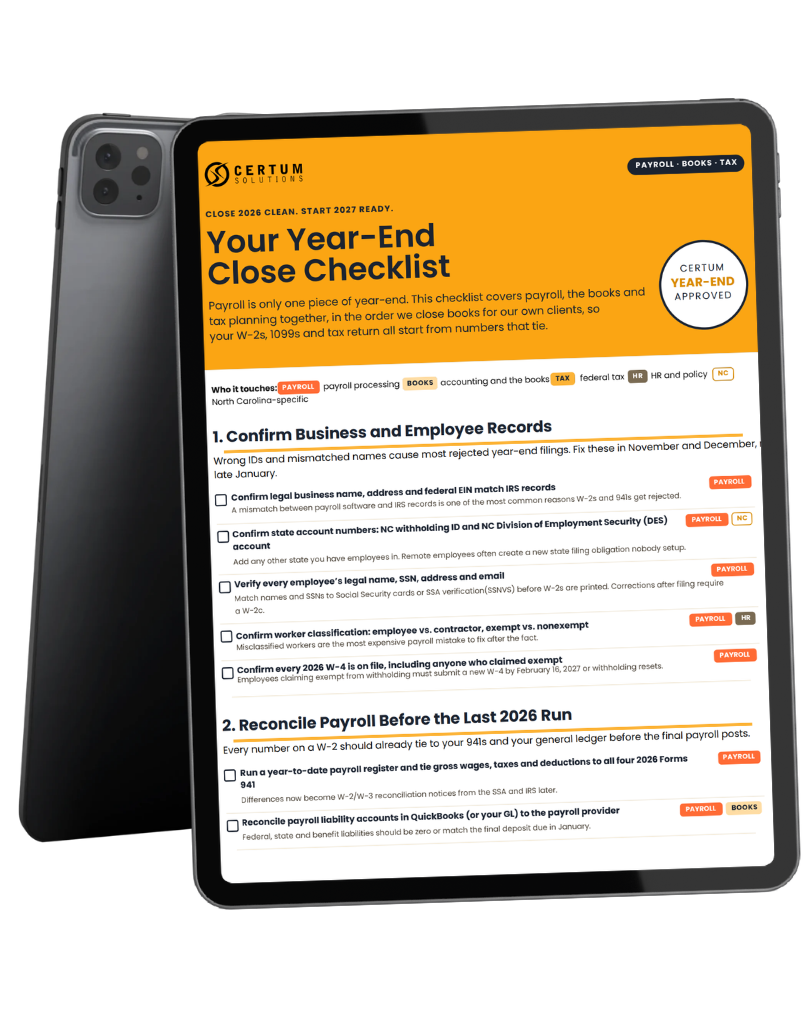
- Certum Year-End Close Checklist: every payroll, books, tax, HR and NC step, tagged by area
- 2027 Payroll Calendar: bank holidays, estimated tax dates, pay period counts and 2027 payroll figures
- 2027 Tax & Compliance Calendar: every federal and North Carolina deadline for 2027, month by month
Download the Year-End Close Checklist
Download the 2027 Payroll Calendar
Download the 2027 Tax & Compliance Calendar
Frequently Asked Questions
What should be on a year-end accounting checklist?
A year-end accounting checklist should cover business and employee record verification, payroll reconciliation to Forms 941, W-2 and 1099 preparation, reconciliation of every bank, credit card and loan account, inventory and fixed asset updates, accruals, sales tax reconciliation, locking the period, and tax moves due by December 31.
What is the 1099 threshold for 2026?
The 1099 threshold for 2026 is $2,000. For payments made after December 31, 2025, businesses file Form 1099-NEC and most Form 1099-MISC boxes only for payees paid $2,000 or more in the year. Payments made in 2025 used the old $600 threshold.
When are W-2s and 1099s due in 2027?
Forms W-2 and 1099-NEC for 2026 are due February 1, 2027, to both recipients and the government. The usual January 31 deadline moves to Monday because January 31, 2027, falls on a Sunday. Paper 1099-MISC filings are due March 1, and electronic 1099-MISC filings are due March 31.
When should a business start its year-end close?
A business should start its year-end close in early November. Collecting W-9s and correcting employee records takes weeks, and tax-saving moves such as placing equipment in service or running final 401(k) deferrals only count if they are completed by December 31.
How do you reconcile payroll at year-end?
To reconcile payroll at year-end, compare the year-to-date payroll register to all four quarterly Forms 941 and to the payroll accounts in your general ledger. Wages, withholding and employer taxes should match across all three, and payroll liability accounts should be zero or equal to the deposit still due in January.
Is a 2026 bonus paid in January 2027 deductible in 2026?
A 2026 bonus paid in January 2027 is deductible in 2026 only for accrual-basis businesses that fix the amount by December 31, 2026, and pay it by March 15, 2027. Cash-basis businesses deduct it in 2027. Bonuses to S corporation shareholders and C corporation owners over 50% are deductible only when paid.
Do I still need to file a BOI report for my LLC?
No. FinCEN’s final rule, effective August 14, 2026, permanently exempts U.S.-formed companies and U.S. persons from beneficial ownership information reporting under the Corporate Transparency Act. Only certain foreign companies registered to do business in the United States still file.
When is the North Carolina S corporation return due in 2027?
The North Carolina S corporation return, Form CD-401S, is due April 15, 2027, for calendar-year companies. That is one month after the federal Form 1120-S deadline of March 15, 2027. North Carolina partnership returns (Form D-403) are also due April 15.
Will my business have 53 pay periods in 2027?
Your business will have 53 pay periods in 2027 if you pay weekly on Fridays, because January 1 and December 31, 2027, both fall on a Friday. Some biweekly Friday payers will have 27 pay periods instead of 26, depending on the date of their first 2027 payday.
What is the 2027 Social Security wage base?
The 2027 Social Security wage base is $192,300, up from $184,500 in 2026, according to the Social Security Administration’s October 14, 2026, announcement. Wages above that amount are not subject to the 6.2% Social Security tax. Medicare tax has no wage cap.
What happens if I file 1099s late?
Late Form 1099 filings carry IRS penalties per form that increase the longer the delay, with separate penalties for failing to furnish the recipient's copy and for failing to file with the IRS. Filing within 30 days of the deadline carries the lowest penalty tier.
Can Certum close our books and file year-end payroll forms for us?
Yes. Certum Solutions handles year-end bookkeeping cleanup, payroll reconciliation and W-2 and 1099 preparation for clients nationwide, with a senior accountant reviewing every engagement. Book a free consultation at certumsolutions.com/book-consultation to review your year-end situation.
Close 2026 with a team that does books
Certum’s US-based team reconciles your books, with senior accountant oversight from start to finish. BBB A+ rated, 500+ businesses served.
RELATED RESOURCES
2026 Tax Calendar for Business Owners →
Moving Payroll from ADP or Gusto to QuickBooks Workforce →
Paychex Payroll and HR Setup →
Inventory Bookkeeping Services →
DISCLAIMER — This article is general information verified as of October 23, 2026 against IRS, Social Security Administration, FinCEN and NC Department of Revenue guidance. It is not tax, legal or accounting advice for your specific situation. When a due date falls on a weekend or legal holiday, it moves to the next business day.